Author: Post
YouTube long take music videos
For an adult ed class I’m going to teach in the spring, please tell me what long take YouTube you used for the YouTube recut assignment. (Adults are not very good at video hunting, and I’d like to give them a list of examples.) If you have suggestions for another film, go ahead and fill out the form twice. And thank you.
The Wilhelm Scream
Rocky montages, I – VI

Once it loads, try clicking various places in Fathom’s Rocky Morphology. Of course it’s about the iconic montages, but more more… (And quite a web-site achievement.)
Assignment: Montage
Show a lot of things happening at once,
Remind everyone of what’s going on
And with every shot you show a little improvement
To show it all would take too long
That’s called a montage
Oh we want montage
Your assignment: make a montage. There are many definitions/subsets of “montage,” but the one that we’ll use is “a series of very short shots edited into a 3 – 4 minute sequence to condense space (at least 4 locations), time (ostensibly at least 4 hours), and information.”
You’re not necessarily telling a whole story, just making a sequence that shows the passage of time, often with “a little improvement,” as Team America has it, or more generally, just “change.” Something needs to be very different at the end than it was at the beginning.
It may help to imagine the story in which this montage fits, but the only part you need to make is the montage itself. Unless you just have to, use no diegetic sound — unify the whole thing with one piece of music, so you don’t have to deal with editing/syncing audio.
Random ideas: have a twist — set up the idea and then surprise us; do an homage — even copy something shot for shot; use your song as inspiration (c.f., almost any music video); think of your shots as video-only — all audio is the soundtrack; use a film convention (or 2 or 2) as inspiration; learn how to cook; learn how to make something; get better at feeding a baby; get a dog to do a trick; learn how to parallel park; conversely, work at something really hard and fail at it, either comically or tragically…
Have a least two shots you are proud of technically. Check out the conventions page to remind you or some; maybe
- a tracking shot (with tripod dolly/skateboard/gutter slider/shpping cart/car/motocycle),
- a rack focus shot,
- a Steadicam Smoothee shot,
- a low-angle shot,
- an aerial shot (GoPro-on-a-stick?),
- a match cut,
- a swish pan;
- etc.
Montages are almost all quick cuts, 30+ per minute, so there should be very few long takes. Note: although maybe 20 seconds can be time lapse / stop motion, the bulk of your piece needs to be a traditional montage.
Please give your final film some ease on both ends — maybe fade from and to black; maybe have credits; please begin and end audio purposefully.
Due date(s): decision/commitment November 26.
Two-legged dolly shots
Nice trick that uses a pivot on two legs of a tripod. The effect is enhanced when there is an object directly on the edge of the camera to pass beside.
American Beauty: the film that wasn’t made
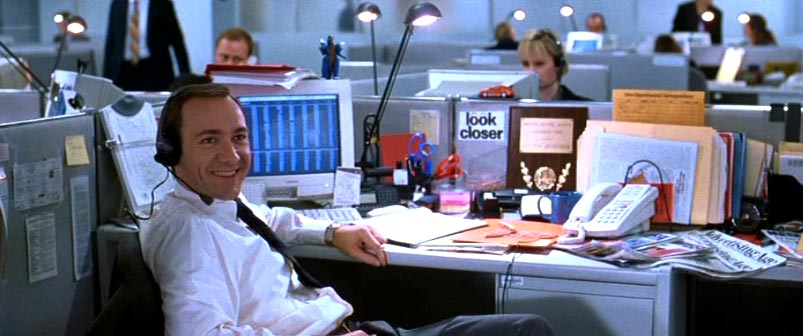
In many (most?) cases, filmmaking is anything but a linear process in which an auteur has a vision, writes the screenplay, storyboards the shots, casts the actors, shoots the scenes, edits the results to match the screenplay. Nope. It’s typically much more messy. That is true for American Beauty, which changed quite a lot from initial script (it was going to be a play) to what happened in post (“As Sam [Mendes] observed during editing, ‘It’s like the movie is letting us know what it wants to be.’ ” – American Beauty, The Shooting Script).
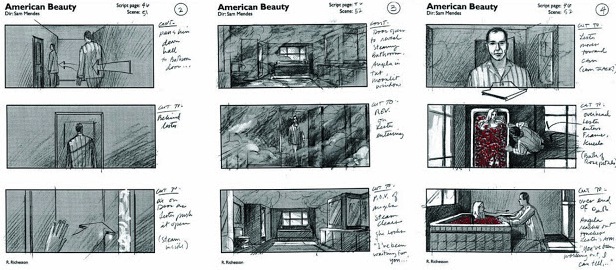
Read the massive (12,000 + words) Wikipedia entry on the film, highlighting everything you see that could have made the film go in a different direction. Then describe and discuss those directions and their meanings, always making clear how they differ from the film that actually was released. Feel free to be opinionated – you can like or dislike anything, both in the rejected possibilities and in the final film.
Ghost Dog vs. American Beauty
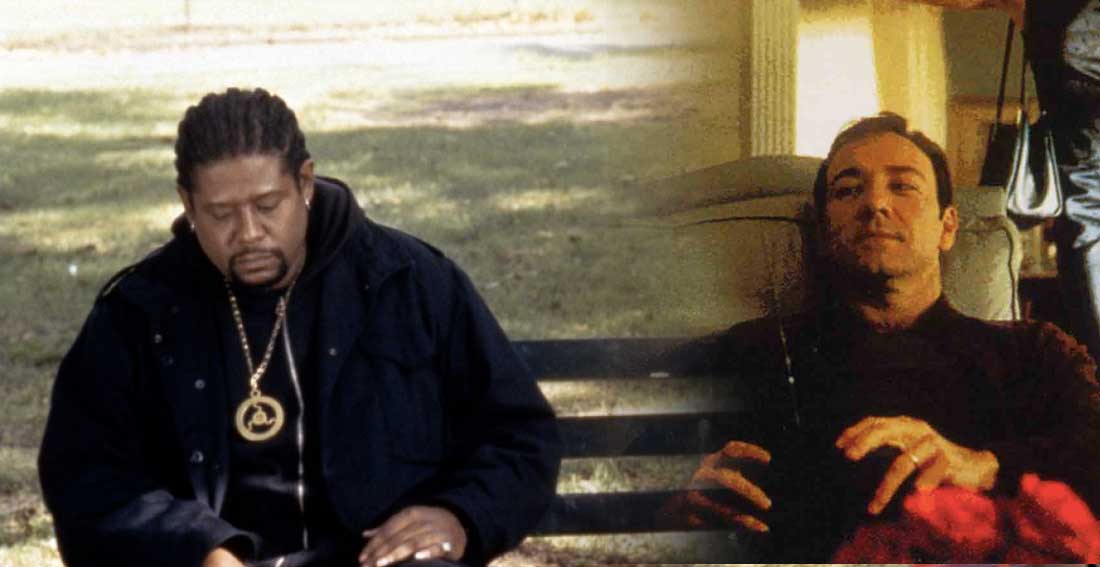
Visual memory. Contrast and compare visual techniques, quirks, and “vocabulary” of Ghost Dog and American Beauty. Remove the actors, the music, the story:
- what techniques are idiosyncratic to each? (how do these differences manifest in the resulting “meaning”?)
- what techniques do they share? (and what is the effect?)
Film school trailers: Ghost Dog
Official trailer:
Student-made trailers:
All of the trailers (necessarily) reduce the film to a smaller number of themes/issues than the whole film. What do they share? How do they differ? Which of the student films do you think is the most “professional”? What seems to be the “get” that the four trailermakers seem to be working as a way to draw people to see the movie (which is of course the function of a trailer: box office). What issues that have come up in class do all the trailers miss/ignore?
Finally, a Jim Jarmusch interview is here. I hope that something(s) surprised you about his pre-production process? What? (If nothing, lie and pretend you were surprised.)
Convert mpg/mpeg video files for iMovie
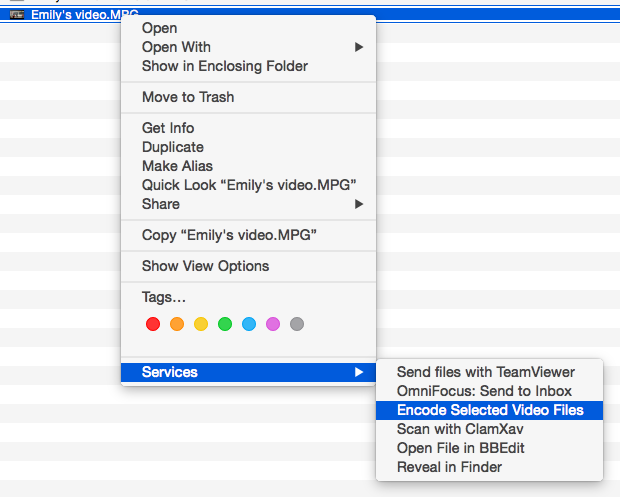
Or use HandBrake and kick it out using the Apple TV 2 or 3 preset. Or import through iPhoto.
 Understanding Film